
The Secret Agent (Portuguese: O Agente Secreto) - The Truths That Refuse to Disappear
Genre: Historical / Political Thriller | Country: Brazil, France, Germany, Netherlands | Language: Portuguese | Original Title: O Agente Secreto | Released: May 18, 2025 (Cannes), November 6, 2025 (Brazil)
7/27/20265 min read
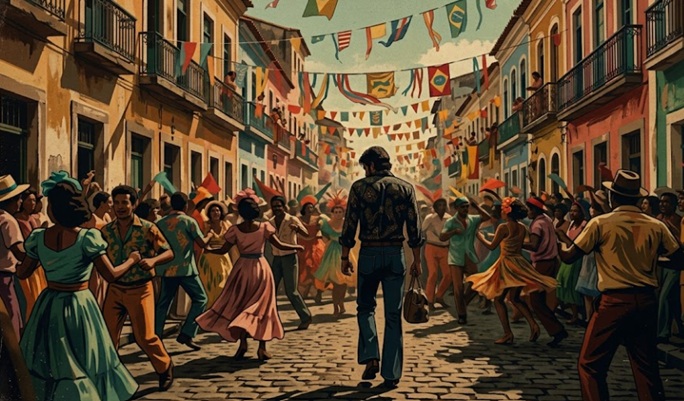
The first surprise of The Secret Agent is hidden in its title. There is no secret agent in the traditional sense. There are no elaborate espionage operations, intelligence networks or undercover missions driving the story. Instead, Kleber Mendonça Filho transforms the idea of a secret agent into something much more unsettling. In a society ruled by fear and surveillance, ordinary people are forced to become secretive. They hide their names, conceal their pasts, protect their families and carefully choose what they can say.
The film is set in Recife in 1977, during the final years of Brazil's military dictatorship. At the centre of the story is Marcelo, played by Wagner Moura, a man returning to the city under a different identity while trying to escape the dangers surrounding him. His journey is not about becoming a hero or defeating an enemy. It is about survival, memory and the search for a place where he can exist without fear.
What makes The Secret Agent powerful is the way it transforms a political story into a deeply personal one. The film is not only about dictatorship as a system of power. It is about what happens to ordinary lives when politics enters every corner of existence. Friendships become uncertain. Conversations become careful. Documents become valuable. Even a person's identity can become something that needs to be protected.
At its heart, the film is about one fundamental human need: the desire to be seen.
Not simply observed, but recognised. To have one's existence acknowledged and respected.
This idea runs through Marcelo's search for his mother's certificate. On the surface, it appears to be a simple bureaucratic task. Gradually, it becomes something much larger. The document represents proof that a person lived, that their story mattered and that they cannot simply disappear from history. In a world where governments can erase records and manipulate narratives, preserving evidence becomes an act of resistance.
The film repeatedly returns to the relationship between memory and identity. A person is not defined only by official records, but those records often become crucial when institutions attempt to deny someone's existence. Photographs, tapes, certificates and personal stories become forms of survival. They protect people from being reduced to forgotten names.
This theme extends into the film's exploration of family. The relationship between the woman and child reflects the emotional consequences of living through political uncertainty. Protection becomes an act of love, but also an act of resistance. The film's later focus on the younger generation reveals how the wounds of history pass from one generation to another. One young character remains determined to uncover the past, while another has given up searching through old tapes, believing they no longer hold meaning. Even the young doctor seems disconnected from earlier struggles, showing how easily societies move away from painful histories.
One of the film's most affecting observations comes through the younger characters describing the older generation: "Grandpa was practically the father." In that simple statement lies an entire history of interrupted families. Political violence does not only affect those directly targeted. It reshapes childhoods, relationships and memories that continue long after the original events have passed.
Cinema itself becomes another form of remembrance. The image of Marcelo's son drawing a movie poster carries special meaning. It suggests that stories survive through imagination as much as through official archives. Films, photographs and personal memories all become ways of preserving lives that history might otherwise overlook.
Mendonça Filho enriches this personal drama with details from the cultural landscape of 1970s Recife. The references to Jaws are particularly meaningful. The famous shark from Spielberg's film represents a danger that exists beneath the surface, unseen but constantly feared. In The Secret Agent, this becomes a metaphor for political violence. The threat is always present, even when daily life continues as normal.
The references to the "Hairy Leg" newspaper stories from the 1970s add another layer. These strange and sensational stories reflect a society where rumours, myths and reality begin to overlap. When official truth becomes unreliable, people search for meaning through stories and speculation. The bizarre becomes a reflection of a world already distorted by fear.
The film's use of Carnival is equally important. Carnival is usually associated with freedom, celebration and public expression. Here, it exists alongside secrecy and anxiety. The streets are full of music, movement and colour, yet many characters are living under constant pressure. The sounds of Carnival continue in the background, creating a powerful contrast between public celebration and private fear.
Beyond politics, The Secret Agent also examines the social divisions within Recife. Class, regional identity and ethnicity influence how people experience power. Some characters can disappear into society, while others are always visible to authority. Mendonça Filho presents these divisions naturally, showing that politics is not separate from everyday life. It exists in workplaces, neighbourhoods and social relationships.
A major strength of the film is its extraordinary ensemble. Wagner Moura delivers a restrained and deeply affecting performance as Marcelo. His character carries fear, exhaustion and uncertainty without relying on dramatic expressions. Much of the emotion exists in his silence, his hesitation and the way he observes the world around him.
However, the film belongs equally to its supporting cast. Almost every character leaves a lasting impression, even those who appear briefly. Mendonça Filho's direction gives each person a sense of history and individuality. The camera does not treat them as background figures. Instead, it allows them to feel like real people whose lives continue beyond the frame.
The technical craftsmanship strengthens this sense of realism. The period recreation of 1970s Recife feels authentic without becoming nostalgic. The production design and costumes create a convincing historical environment, while the cinematography by Evgenia Alexandrova captures the city as both vibrant and unsettling. Eduardo Serrano's editing gives the film a patient rhythm, allowing moments of silence and observation to carry emotional weight. Most importantly, the sound design transforms Recife into a living presence. Carnival music, street sounds, conversations and quiet moments combine to create an atmosphere where celebration and fear exist together.
Why Watch It?
The Secret Agent is worth watching because it offers much more than a political thriller. It is a film about memory, identity, family and the human need to be acknowledged. It tells the story of people who were forced to disappear, but it is ultimately about the ways they continue to exist through the memories of others.
Kleber Mendonça Filho creates a film where history is not presented as something distant or academic. It lives in homes, photographs, conversations and relationships. Wagner Moura's remarkable performance, the carefully constructed world of 1970s Recife and the film's exceptional use of sound and imagery make it an unforgettable cinematic experience.
The film's impact has been recognised internationally. The Secret Agent premiered in competition at the 2025 Cannes Film Festival, where Kleber Mendonça Filho received the Best Director award and Wagner Moura won the Best Actor award. Moura became the first Brazilian actor to receive the honour at Cannes. The film also received the FIPRESCI Prize from the International Federation of Film Critics, further establishing it as one of the most acclaimed films of the year.
Above all, The Secret Agent leaves viewers with a powerful idea: some truths can be hidden for years, but they cannot remain buried forever. Records return. Stories resurface. Families remember. History eventually finds its way back into the light.